
The Blueprint of Learning
“Many people wonder why language acquisition is considered the future of English education. As the director of Monster English Academy, I’ve found the answer through my unique background in architecture.”
Hello everyone,
I’m Carolyn Park, the director of Monster English Academy in Seoul. Before I dive into the world of language, I have a small confession to make: my academic roots are actually in Architecture. I spent years studying structures, blueprints, and the way spaces influence human behavior. But life has a funny way of shifting your perspective. When I transitioned into English education, I realized that learning a language is very much like building a house.
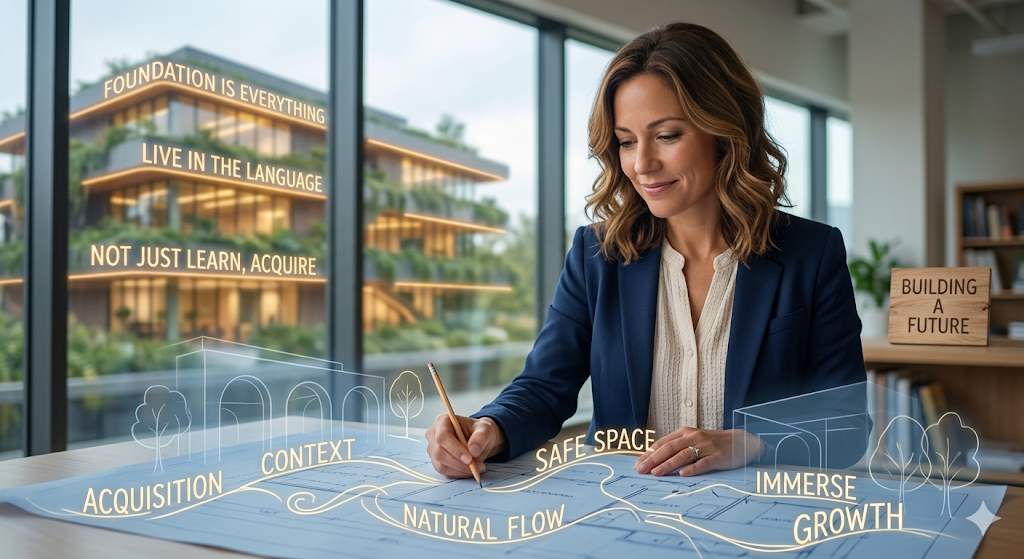
Many traditional systems try to build the roof before the foundation is even set. They force children to memorize grammar rules (the shingles) and vocabulary lists (the paint colors) before the structural frame is even standing. In my experience, especially watching my son Ian and the students at my academy, I’ve realized that English isn’t something you learn; it’s something you acquire.
The Flaw in the Traditional Foundation
In Korea, and many parts of Asia, the “Building” of English has been focused on rote memorization. It’s like trying to stack bricks without any mortar. It looks like a wall for a moment, but as soon as the wind blows—or a student needs to speak in a real-world situation—the whole thing crumbles.
As a mother and an educator, I felt a deep sense of responsibility to change this “structural flaw.” We spend thousands of hours studying, yet so many students feel paralyzed when they step off a plane in New York or London. Why? Because they’ve learned the rules of the building, but they’ve never actually lived in it.

Why ‘Acquisition’ is the Solid Concrete
To my fellow ESL teachers in the US and around the world: you know this struggle well. We see students who can pass a written test but cannot order a sandwich without trembling. At Monster English Academy, I decided to scrap the old blueprints. We moved toward a Natural Acquisition method.
Acquisition is about the “input” being so rich and meaningful that the “output” happens instinctively. In architecture, we talk about the ‘flow’ of a space. In language, acquisition is that flow. It’s about listening and speaking in a way that feels as natural as breathing. We focus on:
- Context over Conjugation: Understanding the ‘why’ and ‘how’ through immersive stories and AI-integrated tools.
- The Safe Space: Just as a building needs a safe foundation, a child needs a safe emotional environment to make mistakes.
- Visual and Structural Learning: Using my background in design to create materials that help students “see” the language, not just read it.
A Message to My Fellow Educators
Whether you are teaching in a bustling academy in Seoul or an ESL classroom in a suburban American middle school, we are all architects of a child’s future. We aren’t just teaching them words; we are giving them the keys to a global room.
I’ve seen students who hated English suddenly find joy when they realized they didn’t have to “study” it—they just had to “be” in it. This shift from learning to acquisition is the most sustainable structure we can provide for them. It’s the difference between a temporary shed and a timeless cathedral.

Building the Future Together
As I prepare for our upcoming summer camp in New York, I’m reminded of my own days at BMCC and the vibrant energy of the city. I want my students to walk those streets not as tourists of a language, but as residents.
If you’re an educator or a parent struggling with the “old way,” I invite you to join me on this journey. Let’s stop building fragile walls and start pouring the solid concrete of acquisition. Our children deserve a language home that lasts a lifetime.
- While building the foundation of English, I also found inspiration during my travels. Check out my [Pompeii food guide] here!
- Meet Carolyn Park
- The Tremble of light upon